

Why Vulnerability Management Is a Critical Pillar of Modern Cyber Security
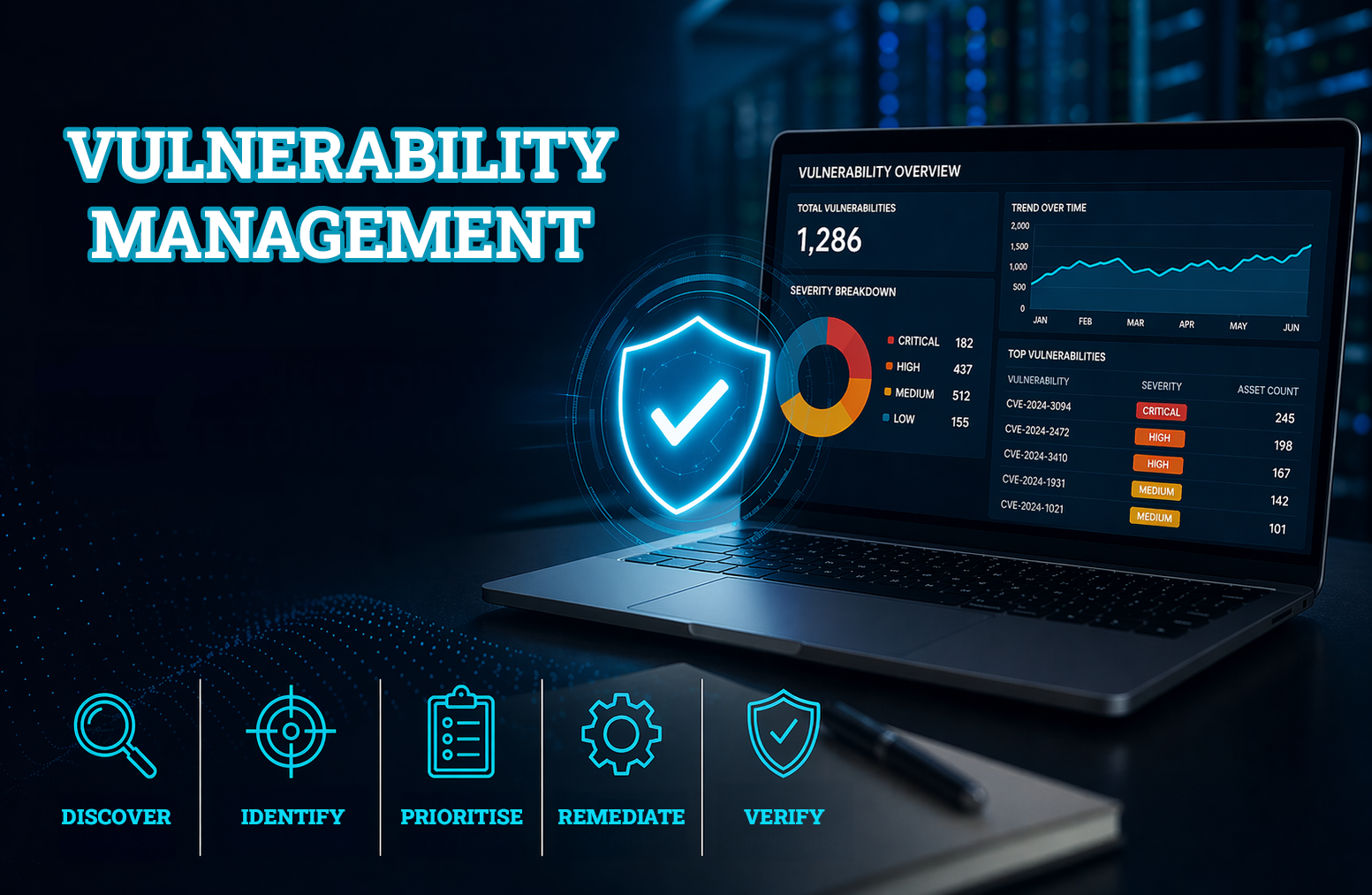
In today’s rapidly evolving digital landscape, organisations face an unprecedented volume and sophistication of cyber threats. From ransomware campaigns to zero-day exploits, attackers are constantly probing for weaknesses they can leverage. Amid this complexity, one foundational practice stands out as essential: vulnerability management.
Far from being a “nice-to-have”, vulnerability management is a critical component of any effective cyber security strategy. It enables organisations to proactively identify, assess and remediate weaknesses before they can be exploited, transforming security from reactive firefighting into a structured, risk-driven discipline.
What Is Vulnerability Management?
Vulnerability management is a continuous, systematic process of identifying, evaluating, prioritising and addressing security vulnerabilities across an organisation’s IT environment.
These vulnerabilities may exist in:
- Operating systems
- Applications and software dependencies
- Network infrastructure
- Cloud environments
- Misconfigurations and exposed services
A mature vulnerability management programme typically includes the following stages:
- Discovery: Identifying all assets within the environment
- Scanning: Detecting known vulnerabilities using automated tools
- Assessment: Determining the severity and potential impact of each vulnerability
- Prioritisation: Ranking vulnerabilities based on risk, exploitability and business context
- Remediation: Fixing vulnerabilities through patching, configuration changes or compensating controls
- Verification: Confirming that vulnerabilities have been effectively resolved
This lifecycle is not a one-time effort. It is continuous and iterative, adapting as new threats and assets emerge.
The Growing Need for Vulnerability Management
Modern IT environments are more complex than ever. Organisations are operating across hybrid infrastructures, integrating third-party services and deploying software at rapid speeds. While this drives innovation, it also significantly expands the attack surface.
At the same time:
- New vulnerabilities are disclosed daily
- Threat actors are automating exploitation at scale
- Time-to-exploit windows are shrinking dramatically
In many cases, attackers exploit vulnerabilities within days, or even hours, of disclosure. Without a structured approach to identifying and remediating these weaknesses, organisations are left exposed.
Key Benefits of Vulnerability Management Solutions
1. Proactive Risk Reduction
Rather than waiting for a breach to occur, vulnerability management allows organisations to identify and mitigate risks before they are exploited. This proactive stance significantly reduces the likelihood of successful attacks.
2. Improved Visibility Across Assets
You cannot secure what you cannot see. Vulnerability management solutions provide comprehensive visibility into all assets, whether on-premises, cloud-based or remote, ensuring nothing falls through the cracks.
3. Risk-Based Prioritisation
Not all vulnerabilities are created equal. Modern solutions go beyond basic severity scoring by incorporating threat intelligence, exploit availability and business context to prioritise what truly matters.
This ensures security teams focus their efforts where they will have the greatest impact.
4. Faster Remediation Cycles
Automation and centralised workflows streamline the remediation process, reducing the time it takes to address vulnerabilities. Faster remediation directly correlates with reduced exposure.
5. Regulatory Compliance Support
Many regulatory frameworks and standards, such as ISO 27001, PCI DSS and GDPR, require organisations to maintain effective vulnerability management practices. Implementing a robust solution helps demonstrate compliance and audit readiness.
6. Enhanced Security Posture
Over time, continuous vulnerability management strengthens an organisation’s overall security posture. It reduces the number of exploitable weaknesses and builds resilience against evolving threats.
Why Vulnerability Management Is Critical Today
The Explosion of Attack Surfaces
With the rise of cloud computing, remote work and IoT devices, the traditional network perimeter has largely disappeared. Every endpoint, application and API represents a potential entry point for attackers.
Vulnerability management ensures these expanding surfaces are continuously monitored and secured.
The Speed of Modern Threats
Cyber criminals are no longer operating manually. They are leveraging automation, artificial intelligence and sophisticated tooling to identify and exploit vulnerabilities at scale.
Organisations that rely on periodic or manual assessments simply cannot keep pace. Continuous vulnerability management is the only viable approach.
The Reality of “Assumed Breach”
Modern security strategies increasingly operate under the assumption that breaches are inevitable. In this context, minimising exploitable vulnerabilities becomes essential to limiting attacker movement and impact.
By reducing the number of entry points, vulnerability management plays a key role in containment and defence-in-depth strategies.
Bridging the Gap Between Security and Operations
One of the biggest challenges in cyber security is aligning security teams with IT and development teams. Vulnerability management solutions help bridge this gap by:
- Providing actionable remediation guidance
- Integrating with ticketing and DevOps workflows
- Enabling collaboration across teams
This alignment is crucial for maintaining security without slowing down business operations.
Common Challenges Without a Vulnerability Management Programme
Organisations that lack a structured approach often face:
- Blind spots in asset visibility
- Overwhelming volumes of unprioritised vulnerabilities
- Delayed or inconsistent patching processes
- Increased risk of breaches and downtime
- Difficulty meeting compliance requirements
Without centralised visibility and prioritisation, security teams can quickly become overwhelmed, leading to critical vulnerabilities being overlooked.
Best Practices for Effective Vulnerability Management
To maximise the value of vulnerability management, organisations should:
- Adopt continuous scanning rather than point-in-time assessments
- Implement risk-based prioritisation aligned with business impact
- Integrate with existing workflows such as ITSM, DevOps and CI/CD pipelines
- Leverage threat intelligence to stay ahead of active exploitation trends
- Regularly validate remediation efforts through rescanning and testing
- Establish clear ownership and accountability for remediation tasks
A successful programme is not just about tools. It is about process, people and alignment across the organisation.
Conclusion
In an era defined by constant cyber threats and expanding attack surfaces, vulnerability management is no longer optional. It is foundational.
By continuously identifying and addressing weaknesses, organisations can significantly reduce their risk, improve operational efficiency and build a resilient security posture.
Ultimately, vulnerability management is not just about fixing flaws. It is about staying ahead of adversaries, making informed risk decisions and ensuring that security keeps pace with innovation.
For organisations looking to strengthen their cyber security strategy, investing in a robust vulnerability management solution is one of the most impactful steps they can take.
Ready to take control of your vulnerability risk?
Now is the time to move from reactive security to proactive resilience.